Queen Bed Size Guide: Dimensions, Room Fit, and Is It Right for You?


Choosing a Queen bed size seems like a safe and simple decision — but in real life, it affects much more than just how you sleep.
A Queen bed must fit your room layout, walking space, nightstands, doors, and even delivery path. It also determines how easy the bed frame will be to assemble and how comfortable it will feel long-term.
This is why a Queen bed is often called the “default choice” — but that does not always mean it is the right one for your space.
Quick Answer: Is a Queen Bed the Right Choice?
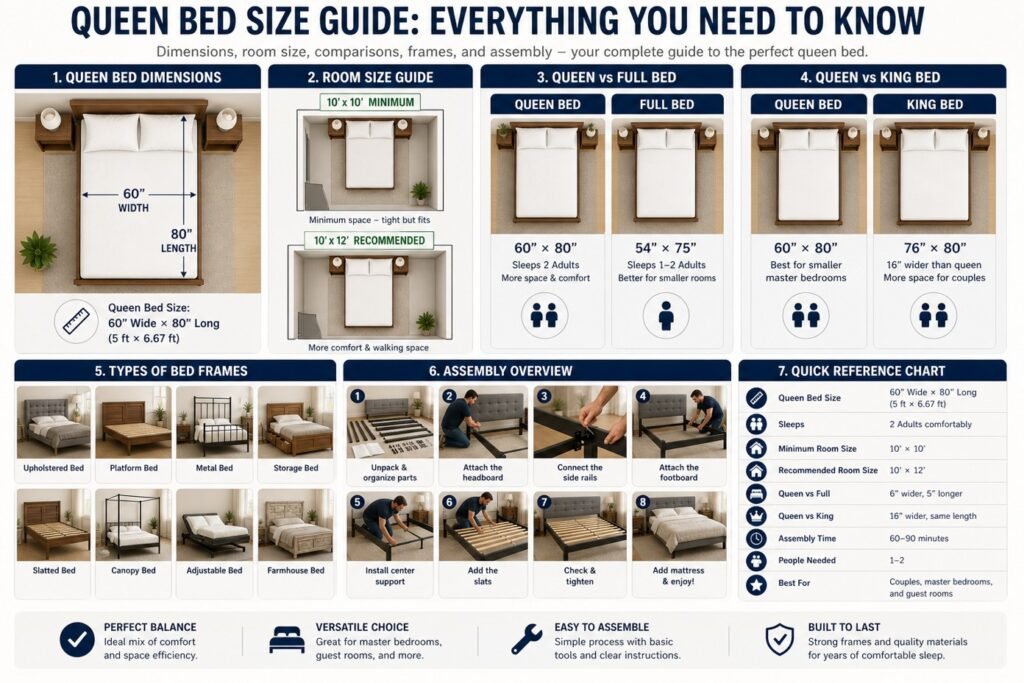
Size
60″ × 80″
Standard Queen mattress dimensions
Best For
Couples, apartments, primary bedrooms
Room Size
Minimum: 10′ × 10′
Assembly
Medium difficulty
Usually requires 2 people
Designer’s Note
A Queen bed is often the best balance between comfort and room flow. It provides enough sleeping space without overwhelming most bedrooms, especially in apartments and condos.
Furniture Assembler’s Note
Queen bed frames are manageable in most cases, but complexity depends on the design. Storage beds, large headboards, and heavy materials can make assembly more time-consuming than expected.
Queen Bed Dimensions: Full Size Breakdown
A Queen bed has standard mattress dimensions, but the real size of the bed is always bigger because of the frame, headboard, and structure.
Below is a practical breakdown that shows not just the mattress size, but also how much space a Queen bed actually takes in a real bedroom.
Mattress Size
60″ × 80″
Standard Queen mattress dimensions
Typical Bed Frame Size
62″–68″ × 82″–88″
Depends on frame design and materials
Minimum Room Size
10′ × 10′
Basic fit with limited clearance
Comfortable Room Size
10′ × 12′ or larger
Better for walking space and furniture
Why This Matters in Real Life
The difference between 60 inches (mattress) and 65+ inches (frame) may seem small — but in a bedroom, it can affect:
- Whether nightstands fit
- How much walking space you have
- If drawers or closet doors can open
- How comfortable the room feels overall
Furniture Assembler’s Note
From an assembly perspective, Queen beds are where things start to get more complex. Longer side rails, center support beams, and heavier headboards require more space during installation.
Queen Mattress Size vs Bed Frame Size: Why the Bed Is Always Bigger
One of the most common mistakes people make is assuming that a Queen bed takes up exactly 60″ × 80″ — the same as the mattress.
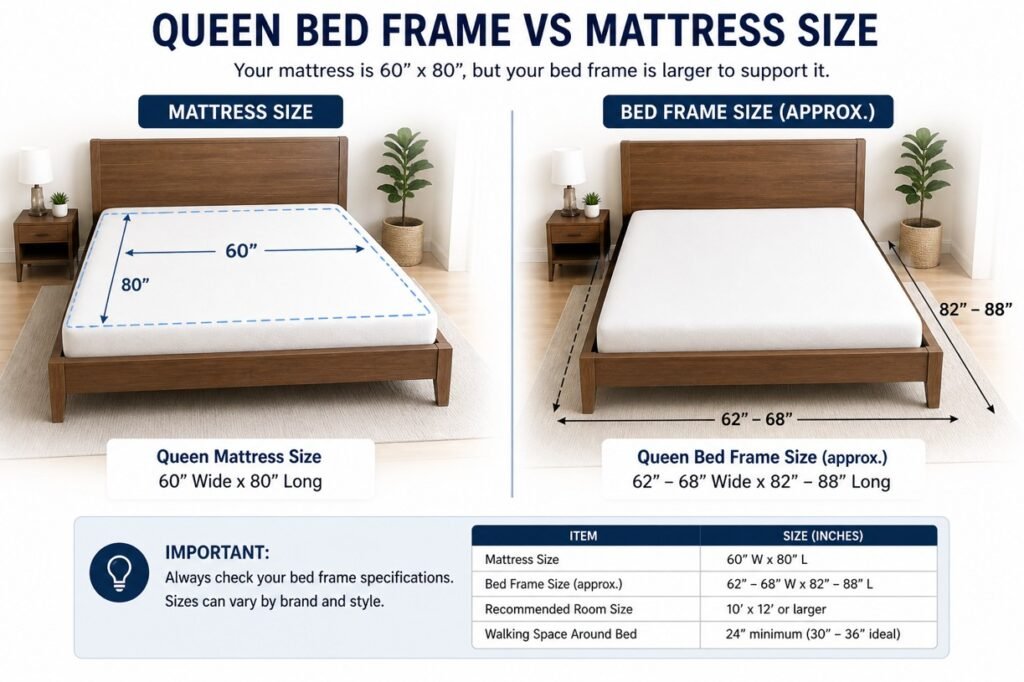
A queen mattress is 60″ × 80″, but the full bed frame can be several inches larger depending on the design.
In reality, the mattress is only part of the setup. The bed frame always adds extra width and length, sometimes by several inches on each side.
This difference may seem small on paper, but in real bedrooms — especially apartments and condos — it can completely change how the space feels and functions.
What Adds Extra Size to a Queen Bed?
Different bed frame types increase the total footprint in different ways:
- Upholstered beds → thicker sides due to padding
- Platform beds → may extend beyond the mattress edges
- Storage beds → bulkier base + drawer space
- Beds with large headboards → add extra depth
- Modern designer frames → often wider for aesthetics
Queen Mattress
60″ × 80″
Actual sleeping surface
Simple Frame
62″–64″ × 82″–84″
Minimal added size
Upholstered Frame
64″–68″ × 84″–88″
Extra padding increases width
Storage Bed
66″+ × 86″+
Requires space for drawers
Real-Life Impact
Even an extra 3–5 inches on each side can:
- Eliminate space for nightstands
- Reduce walking clearance
- Make the room feel cramped
- Block drawers or closet doors
That is why planning based only on mattress size often leads to problems after delivery.
Designer’s Note
When planning a bedroom layout, always work with the full bed footprint, not just the mattress. This helps maintain proper spacing and prevents the room from feeling overcrowded.
Furniture Assembler’s Note
Larger bed frames require more assembly space than people expect. In tight rooms, assembling a Queen storage bed or upholstered frame can be significantly harder because there is less room to position and align parts.
Is a Queen Bed Big Enough for Two Adults?
A Queen bed is designed for two people, but whether it feels comfortable depends on how much personal space you need.
With a width of 60 inches, each person gets about 30 inches of space — which is roughly the same as a Twin bed per person.
For many couples, this is enough. But for others, it can feel tight, especially over time.
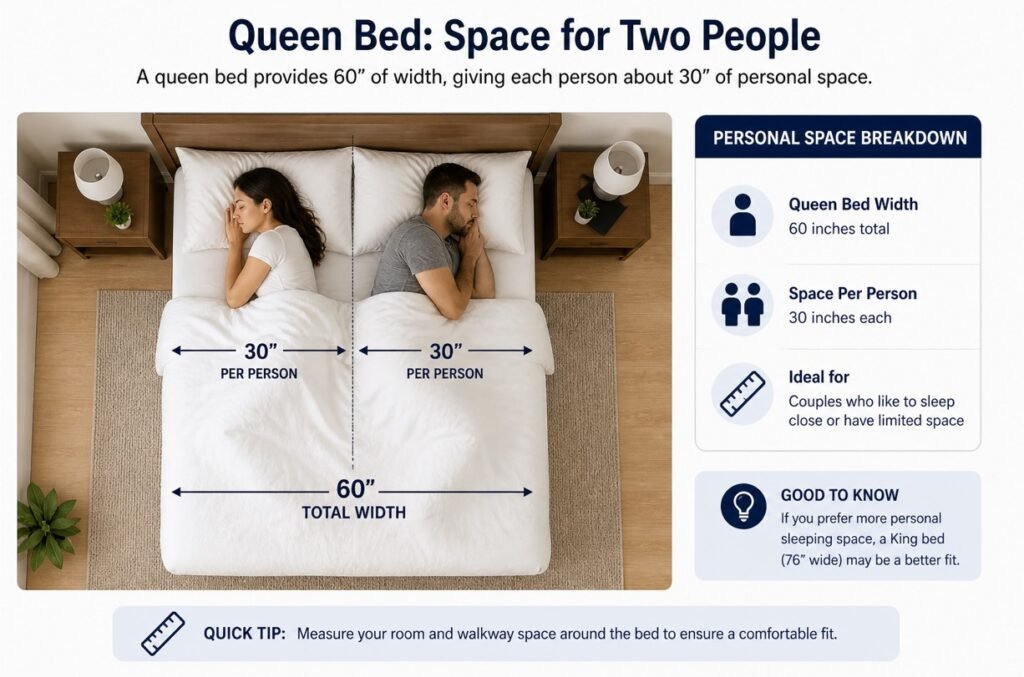
A queen bed offers 60 inches of total width, giving each person about 30 inches of sleeping space.
How Much Space Do You Actually Get?
Total Width
60 inches
Full width of a Queen bed
Per Person
~30 inches each
Same as a Twin bed per person
When a Queen Bed Is Comfortable for Two
A Queen bed works well if:
- You and your partner sleep relatively still
- You don’t need a lot of personal space
- You are working with a standard bedroom or apartment
- You want a balance between comfort and room size
When It May Feel Too Small
A Queen bed can feel tight if:
- One or both of you move a lot during sleep
- You sleep with pets or kids
- You prefer more personal space between you
- You are used to a larger bed (like a King)
Quick Comparison: Queen vs King (Space Per Person)
- Queen: ~30 inches per person
- King: ~38 inches per person
That extra 8 inches per person makes a noticeable difference.
Designer’s Note
A Queen bed is often the best compromise between comfort and space efficiency. In smaller bedrooms, upgrading to a King can reduce movement space and make the room feel crowded.
Furniture Assembler’s Note
From an installation perspective, many couples choose a Queen instead of a King because it is easier to handle. A Queen bed frame is simpler to position, assemble, and fit into tighter rooms.
Real-Life Tip
If you are unsure, think about how you actually sleep — not just how the bed looks in the store. Comfort over time matters more than initial impression.
What Room Size Do You Need for a Queen Bed?
A Queen bed may fit into a room on paper, but that does not mean the room will feel comfortable.
The real question is not “Does it fit?” — it’s
👉 “Can you actually live in the space comfortably?”
To answer that, you need to think beyond the bed itself and consider movement, furniture, and layout.
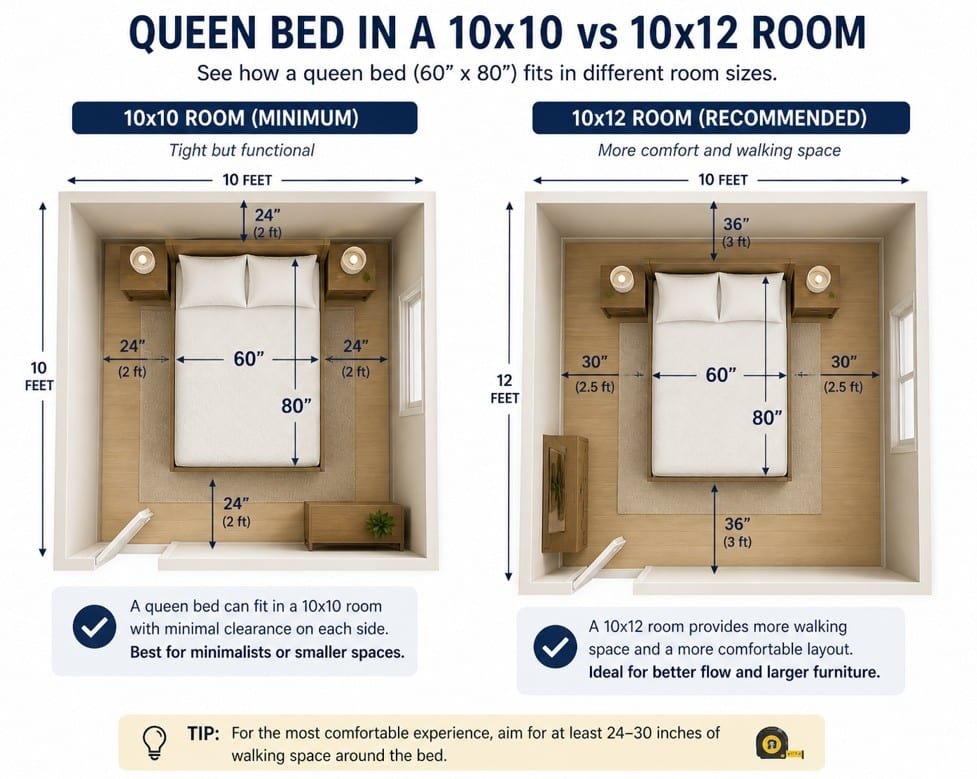
A queen bed can fit in a 10×10 room, but a 10×12 layout provides better walking space and comfort.
Recommended Room Sizes for a Queen Bed
Minimum Fit
10′ × 10′
Bed fits, but limited walking space
Comfortable Layout
10′ × 12′
Room for nightstands and movement
Ideal Setup
12′ × 12′ or larger
Full layout with extra furniture
Small Apartment Tip
Use slim nightstands or skip one side
How Much Walking Space Do You Need?
A common mistake is placing the bed too close to walls or furniture.
👉 Recommended clearance:
- 24 inches minimum (tight but usable)
- 30–36 inches ideal (comfortable movement)
This space is important for:
- Getting in and out of bed
- Opening drawers and closet doors
- Cleaning and daily movement
What Else Takes Space in the Room?
A Queen bed is only part of the layout. You also need space for:
- Nightstands (18″–24″ each)
- Closet doors
- Dressers or storage units
- Door swing clearance
Ignoring these elements is one of the biggest reasons bedrooms feel cramped.
Designer’s Note
When planning a bedroom, always design around movement first, bed second. A slightly smaller bed in a well-planned room often feels more comfortable than a large bed in a tight space.
Furniture Assembler’s Note
From an assembly standpoint, tight rooms make the process much harder. You need enough space not only for the final bed placement, but also to position parts, align rails, and install support systems.
Small-Space Tip
If your room is close to the minimum size:
- Use a low-profile bed frame
- Choose a wall-mounted or narrow nightstand
- Avoid bulky headboards
These small changes can make a big difference in how the room feels.
Queen vs Full Bed: What’s the Real Difference?
At first glance, a Full and Queen bed may seem similar. The difference is only 6 inches in width and 5 inches in length, but in real life, that difference is very noticeable.
For many people, choosing between Full and Queen comes down to space vs comfort.
Key Size Difference
- Full: 54″ × 75″
- Queen: 60″ × 80″
👉 Queen is both wider and longer, which makes it significantly more comfortable for most adults.
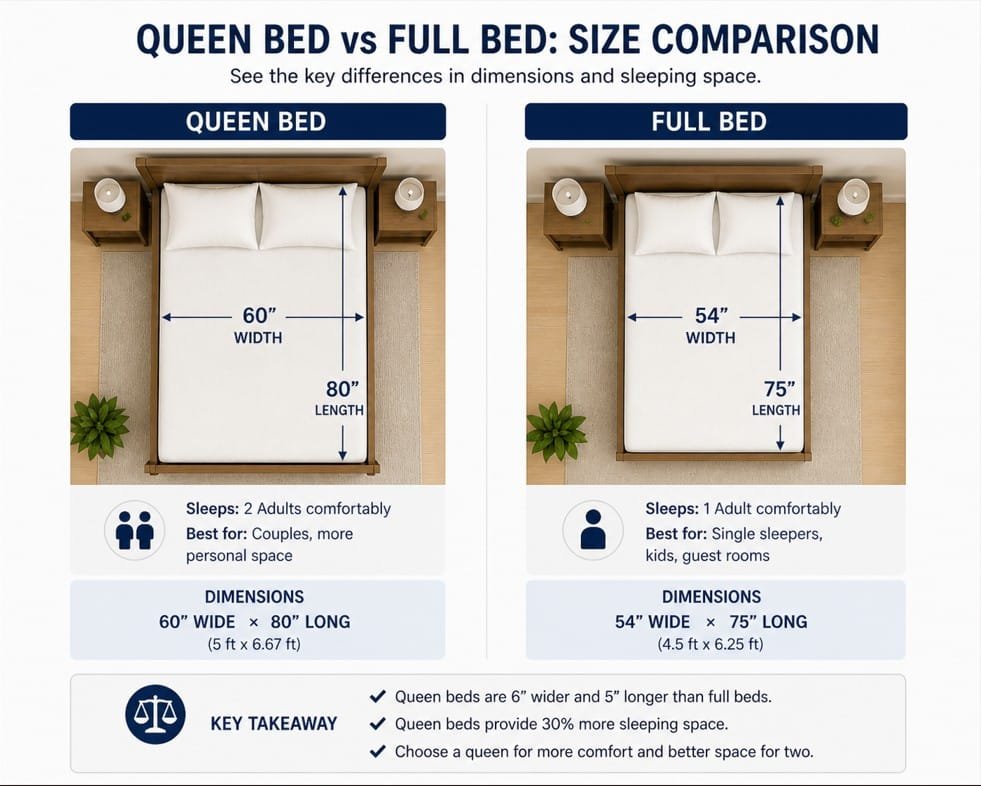
A queen bed is wider and longer than a full bed, offering more comfort for adults and couples.
Full Bed
Size: 54″ × 75″
Best for: One adult
Room fit: Smaller bedrooms
Comfort: Limited for two people
Queen Bed
Size: 60″ × 80″
Best for: Couples
Room fit: Standard bedrooms
Comfort: Balanced and practical
When to Choose a Full Bed
A Full bed makes sense if:
- You are a single sleeper
- Your room is smaller than 10′ × 10′
- You want to save space and budget
When to Choose a Queen Bed
A Queen bed is better if:
- You are a couple
- You want more sleeping space and comfort
- You have a standard or larger bedroom
Designer’s Note
In smaller rooms, a Full bed can create a better overall layout by leaving more walking space. However, for long-term comfort, especially for couples, a Queen bed is usually the better investment.
Furniture Assembler’s Note
Full bed frames are easier to assemble and move due to their smaller size. Queen beds require more space during installation, but they offer better long-term usability, which often justifies the extra effort.
Real-Life Tip
If your room can fit a Queen bed comfortably, it is usually worth upgrading. The difference in comfort over time is significant, especially for everyday use.
Queen vs King Bed: Which One Should You Choose?
Choosing between a Queen and a King bed is one of the most common decisions when furnishing a bedroom.
Both options are comfortable, but they serve different needs. The choice usually comes down to space in the room vs personal space in bed.
Key Size Difference
- Queen: 60″ × 80″
- King: 76″ × 80″
👉 A King bed is 16 inches wider — that’s an extra 8 inches per person.
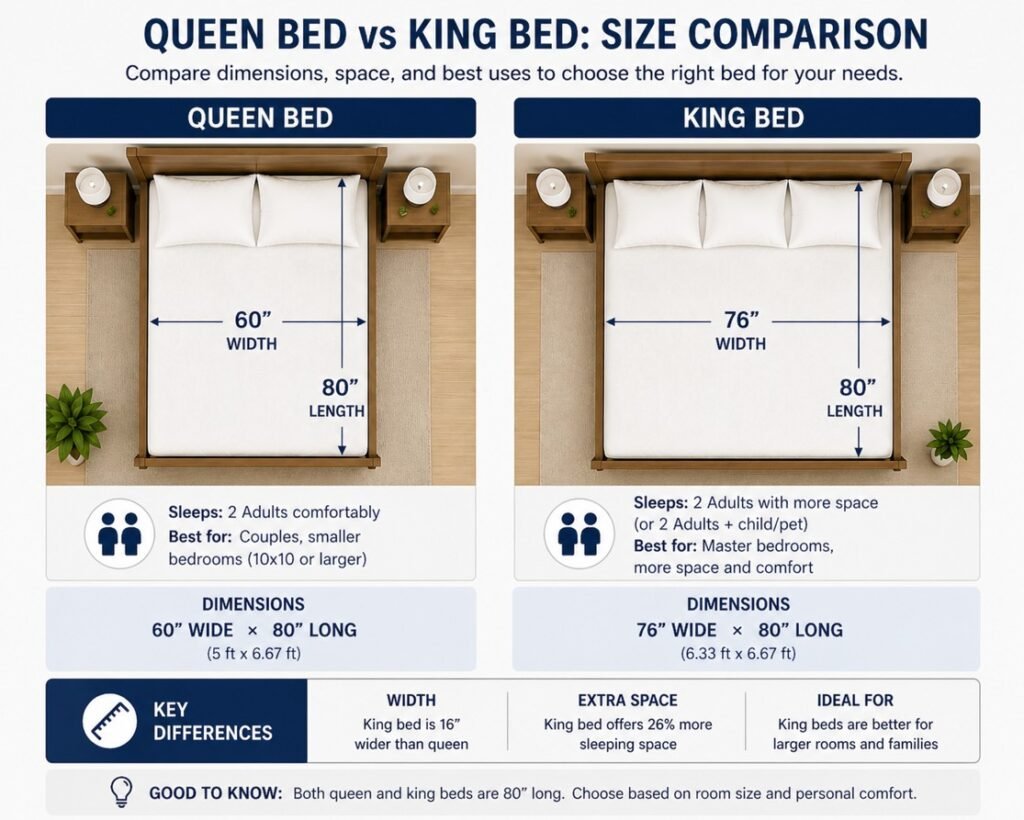
A king bed is 16 inches wider than a queen, offering more personal space for couples.
Queen Bed
Size: 60″ × 80″
Best for: Most couples
Room fit: Easier in apartments
Assembly: Medium
King Bed
Size: 76″ × 80″
Best for: Maximum space
Room fit: Needs larger room
Assembly: Medium–Hard
When a Queen Bed Is the Better Choice
A Queen bed is the smarter option if:
- You live in an apartment or condo
- Your bedroom is around 10′ × 10′ to 10′ × 12′
- You want a balance between comfort and usable space
- You need something easier to move and assemble
When a King Bed Is Worth It
A King bed makes sense if:
- You want maximum personal space
- You sleep with pets or kids
- Your bedroom is 12′ × 12′ or larger
- You prefer a more luxury feel
Real Difference in Daily Use
The extra 16 inches in a King bed can make a big difference if:
- One person moves a lot during sleep
- You prefer more distance between you
- You want more flexibility in sleeping positions
Designer’s Note
A King bed can look impressive, but in smaller rooms it often makes the space feel cramped. A Queen bed usually creates a more balanced and functional layout.
Furniture Assembler’s Note
King bed frames are significantly harder to assemble due to longer rails, heavier parts, and tighter installation conditions in smaller rooms. A Queen bed is usually much easier to handle, especially in apartments.
Real-Life Tip
If your room is borderline in size, choose a Queen.
If your room is clearly large, then a King becomes a better upgrade.
Best Queen Bed Frames by Room Type
Not all Queen beds are the same. The type of bed frame you choose can change how your room looks, feels, and functions — even if the mattress size stays the same.
Choosing the right frame is just as important as choosing the bed size itself.
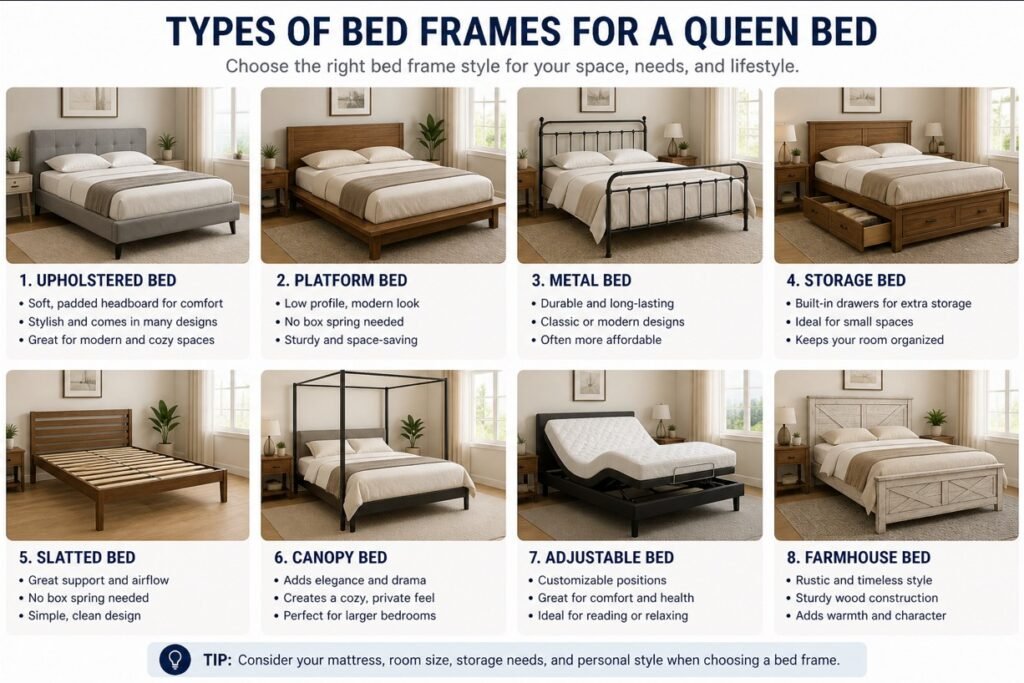
Different queen bed frame styles can affect space, comfort, and overall bedroom layout.
Platform Bed
Best for: Modern apartments
✔ Clean look
✔ Lower profile
✔ No box spring needed
Storage Bed
Best for: Small spaces
✔ Built-in drawers
✔ Saves closet space
✘ Needs extra clearance
Upholstered Bed
Best for: Comfort & design
✔ Soft headboard
✔ Luxury feel
✘ Bulkier frame
Metal Frame
Best for: Budget & simplicity
✔ Lightweight
✔ Easy to assemble
✘ Basic look
Adjustable Base
Best for: Comfort & health
✔ Adjustable positions
✔ Works with split setups
✘ Higher cost
How to Choose the Right Frame
Think about your priorities:
- Small room → platform or storage bed
- Design focus → upholstered bed
- Budget setup → metal frame
- Maximum comfort → adjustable base
Designer’s Note
The bed frame is one of the largest visual elements in a bedroom. A bulky upholstered frame can make a small room feel tighter, while a low-profile platform bed can make the space feel more open.
Furniture Assembler’s Note
Frame type directly affects assembly time:
- Metal frames → fast and simple
- Platform beds → moderate
- Storage beds → time-consuming
- Adjustable bases → heavy and complex
Choosing the wrong frame can turn a simple setup into a long installation process.
Small-Space Tip
If your room is close to the minimum size for a Queen bed, avoid bulky frames and storage beds. A simple, low-profile frame will keep the room functional.
Queen Bed Assembly Difficulty: What to Expect
A Queen bed is considered medium difficulty when it comes to assembly, but that can change quickly depending on the bed design.
Some frames can be assembled in under an hour, while others — especially storage or upholstered beds — may take significantly longer.
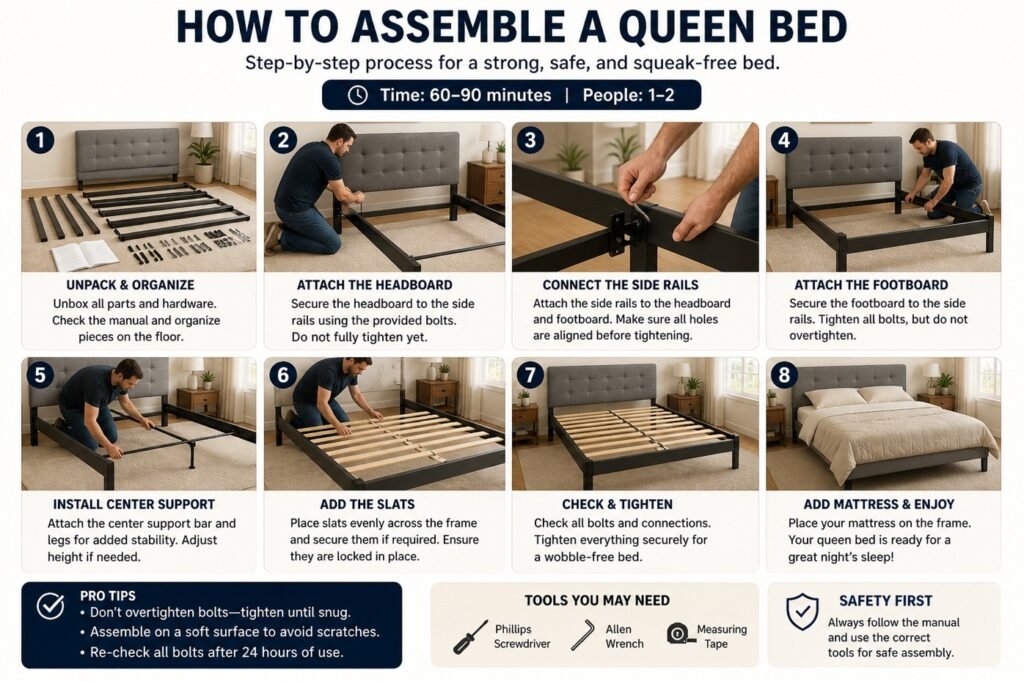
Assembling a queen bed frame can take 60–90 minutes depending on the design and experience.
Basic Metal Frame
Difficulty: Easy
Fast setup, minimal tools required
Platform Bed
Difficulty: Medium
Slats and support system require alignment
Upholstered Bed
Difficulty: Medium–Hard
Heavy parts and bulky headboard
Storage Bed
Difficulty: Hard
Drawers and extra components increase time
Adjustable Base
Difficulty: Hard
Heavy and requires careful positioning
How Long Does It Take?
Typical assembly time:
- Simple frame: 30–60 minutes
- Standard Queen bed: 60–90 minutes
- Storage / complex beds: 1.5–3 hours
What Makes Assembly Harder
Even a Queen bed can become difficult if:
- Instructions are unclear
- Parts are mislabeled
- You are working in a tight room
- The bed has many components (drawers, lift system)
Furniture Assembler’s Note
Most assembly issues don’t come from the size — they come from design complexity and limited space. In apartments and condos, lack of working space is often the biggest challenge.
When It Makes Sense to Hire a Professional
Consider professional assembly if:
- The bed is heavy or complex
- You don’t have tools or time
- The room is tight
- You want everything aligned correctly from the start
Real-Life Tip
Trying to assemble a Queen bed in a small bedroom without planning space can double the time and effort required.
Common Mistakes When Choosing a Queen Bed
A Queen bed is often seen as a “safe choice,” but many people still run into problems after buying one.
Most of these issues are not about the bed itself — they come from poor planning and incorrect assumptions.
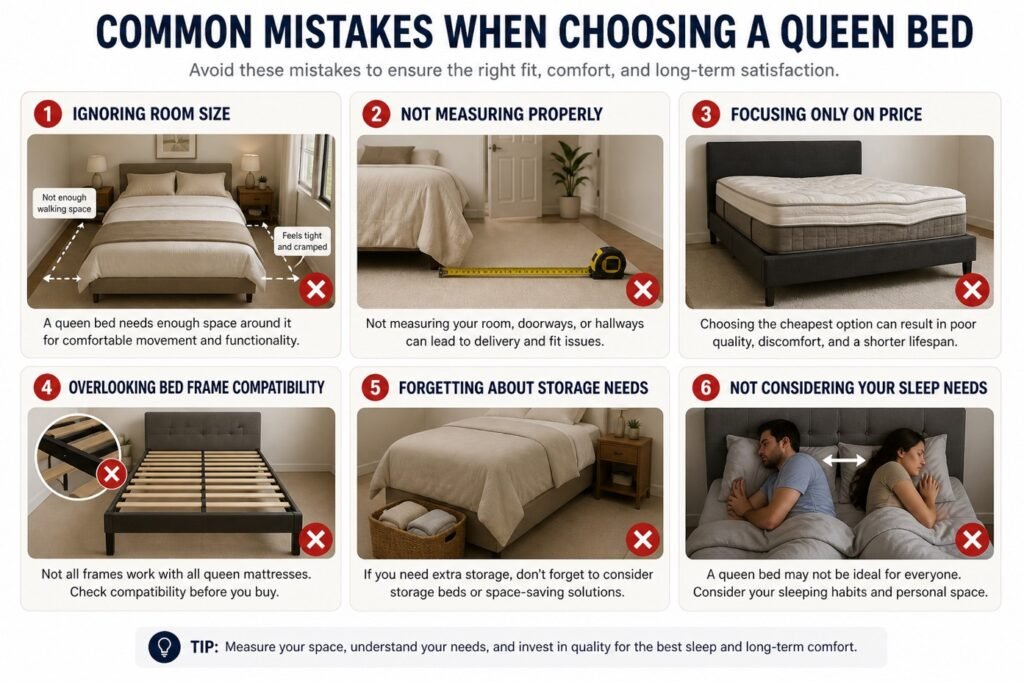
Many problems with a queen bed come from poor planning, not the bed size itself.
Measuring Only the Mattress
Ignoring the extra size of the bed frame leads to tight layouts.
Choosing a Bulky Frame
Large upholstered beds can take more space than expected.
No Walking Space
Placing the bed too close to walls makes the room hard to use.
Forgetting Nightstands
No space left for basic functionality next to the bed.
Ignoring Door & Closet Clearance
Doors and drawers may not open properly after installation.
Not Planning Delivery Access
Bed parts may not fit through hallways, stairs, or elevators.
Underestimating Assembly Time
Complex beds take longer than expected to assemble.
Choosing Size Without Lifestyle
Ignoring sleep habits, pets, or space needs.
Why These Mistakes Happen
Most people focus only on bed size in inches, but forget about:
- Full room layout
- Furniture placement
- Real-life movement
- Assembly conditions
Designer’s Note
A well-designed bedroom is not about fitting the largest bed — it is about creating a space that feels comfortable and functional every day.
Furniture Assembler’s Note
Many assembly problems happen not because the bed is complicated, but because the room was not planned properly. Limited space makes even simple installations much harder.
Real-Life Tip
Always plan your room as a whole — not just the bed.
A slightly smaller bed in a well-organized space will always feel better than a large bed in a cramped room.
Queen Bed in South Florida Apartments and Condos
In South Florida, choosing a Queen bed is often not just about comfort — it is about practical limitations of the space and building layout.
Apartments, condos, and high-rise buildings in areas like Boca Raton, Fort Lauderdale, West Palm Beach, and Delray Beach often have restrictions that directly affect bed size decisions.
What Makes Queen Beds a Smart Choice in Condos
Compared to King beds, a Queen is much easier to handle in real-life conditions:
- Fits better in standard bedrooms (10′ × 10′ to 10′ × 12′)
- Easier to move through hallways and elevators
- Leaves more room for furniture and walking space
- More practical for tight layouts and corners

A queen bed is one of the most practical choices for apartments and condos in South Florida.
Elevator Limits
Long bed parts must fit inside small elevators.
Tight Hallways
Turning large frames can be difficult in narrow spaces.
Small Bedrooms
Queen fits where King would feel too tight.
Delivery Restrictions
Some buildings limit moving hours and access.
Real-Life Scenarios
- A King bed may technically fit the room — but not fit through the elevator
- A large upholstered frame may block closet doors
- Storage beds may not open fully due to limited clearance
These are common issues in South Florida properties.
Designer’s Note
In condos and apartments, a Queen bed often creates a more balanced and livable space. It allows room for movement, nightstands, and better overall layout.
Furniture Assembler’s Note
From experience, Queen beds are the most practical size to assemble in South Florida homes. Larger beds like King and California King often create challenges due to limited working space and building constraints.
When Professional Assembly Makes Sense
In many cases, the challenge is not just assembling the bed — it is doing it within the space available.
Professional help is especially useful when:
- The room is tight
- The bed frame is heavy or complex
- The building has access restrictions
- You want the setup done quickly and correctly
Related Guides and Helpful Resources
If you are choosing a Queen bed, it is helpful to understand not only the size, but also assembly, layout planning, and comparisons with other bed types.
These guides will help you go further.
Compare all mattress sizes including Twin, Full, Queen, King, and California King.
See how a Full bed compares to a Queen in smaller rooms.
Understand when upgrading from Queen to King makes sense.
Step-by-step instructions for one of the most popular bed frames.
What to expect when assembling Ashley bed frames.
Professional help for fast and reliable bed frame assembly.
FAQ: Queen Bed Size, Room Fit, and Assembly
What size is a Queen bed in inches?
A standard Queen bed measures 60 inches wide and 80 inches long.
Is a Queen bed big enough for two adults?
Yes, a Queen bed is comfortable for most couples. However, if you prefer more personal space or sleep with pets, a King bed may be a better option.
What room size is best for a Queen bed?
A Queen bed fits best in a room at least 10′ × 10′, but a 10′ × 12′ room or larger is recommended for better comfort and layout.
How much space do you need around a Queen bed?
You should leave at least 24 inches of walking space, but 30–36 inches is ideal for comfortable movement.
How big is a Queen bed frame compared to the mattress?
A Queen mattress is 60″ × 80″, but the full bed frame is usually larger, around 62–68 inches wide and 82–88 inches long depending on the design.
Is a Queen bed better than a Full bed?
Yes, a Queen bed is wider and longer than a Full bed, making it more comfortable for adults and couples.
What is the difference between a Queen and a King bed?
A King bed is 16 inches wider than a Queen, providing more personal space, but it requires a larger room.
Is a Queen bed good for small apartments?
Yes, a Queen bed is often the best option for apartments because it balances comfort and space without overwhelming the room.
How hard is it to assemble a Queen bed frame?
Queen bed frames are considered medium difficulty. Most require two people and take about 45–90 minutes to assemble.
Should I hire someone to assemble a Queen bed?
If the bed is heavy, complex, or the room is tight, professional assembly can save time and ensure proper installation.
Is a Queen Bed the Right Choice for You?
A Queen bed remains the most practical and versatile option for most bedrooms.
It offers:
- Enough space for two people
- A size that fits in most rooms
- A balance between comfort and functionality
For apartments, condos, and standard homes, a Queen bed is often the best overall choice — not too small, not too large.
Final Tip Before You Buy
Before choosing a Queen bed, make sure to:
- Measure the full bed frame size, not just the mattress
- Plan for walking space and furniture placement
- Check doorways, hallways, and delivery access
- Consider the type of frame and assembly complexity
A few extra minutes of planning can prevent layout problems and save time during setup.
Need Help with Queen Bed Assembly?
If you’ve already purchased a Queen bed and want to avoid the hassle of tools, instructions, and heavy parts, professional assembly can make the process faster and easier.
Furniture Assembly US provides:
- Queen bed frame assembly
- IKEA, Wayfair, Amazon, and Ashley Furniture beds
- Fast and reliable service in South Florida
We work in:
- Boca Raton
- Fort Lauderdale
- West Palm Beach
- Delray Beach
- Boynton Beach
- Pompano Beach
- Deerfield Beach
- Hollywood
- All Broward County and Palm Beach County
👉 Whether you are setting up a new bedroom or upgrading your space, proper assembly ensures your bed is stable, safe, and built to last.