Bed Sizes Chart: Twin, Full, Queen, King, and California King Explained


Choosing the right bed size sounds simple — until the bed frame arrives, the boxes are heavier than expected, and you realize the mattress is not the only thing you needed to measure.
A Twin, Full, Queen, King, or California King bed is not just about sleeping space. It also affects how your bedroom feels, whether you can open closet doors, where your nightstands fit, how easy the bed is to move through hallways or elevators, and how difficult the bed frame will be to assemble.
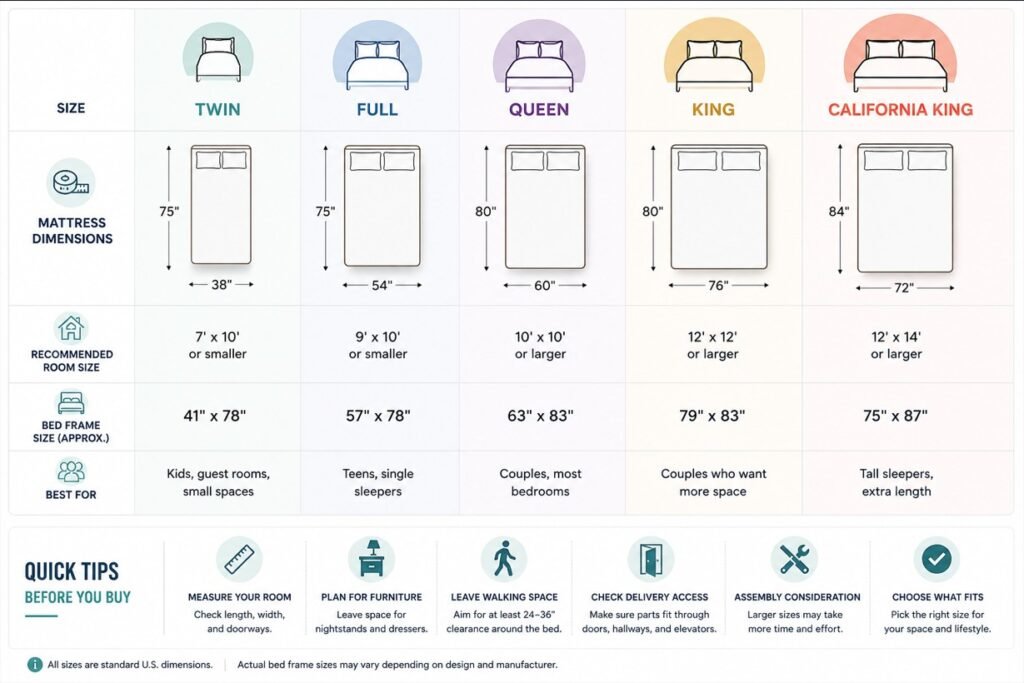
This guide explains standard U.S. bed sizes, mattress dimensions, room planning tips, bed frame footprint, and assembly difficulty so you can choose the right bed before you buy. Standard U.S. mattress dimensions are commonly listed as Twin 38″ × 75″, Twin XL 38″ × 80″, Full 54″ × 75″, Queen 60″ × 80″, King 76″ × 80″, and California King 72″ × 84″.
If you are buying a bed frame in South Florida — especially for an apartment, condo, guest room, or primary bedroom — think beyond the mattress size. Measure the room, check doors and elevators, and consider whether DIY assembly is realistic. Furniture Assembly US serves Broward and Palm Beach County and specializes in assembling IKEA, Wayfair, Amazon, Ashley, Target, and other major furniture brands.
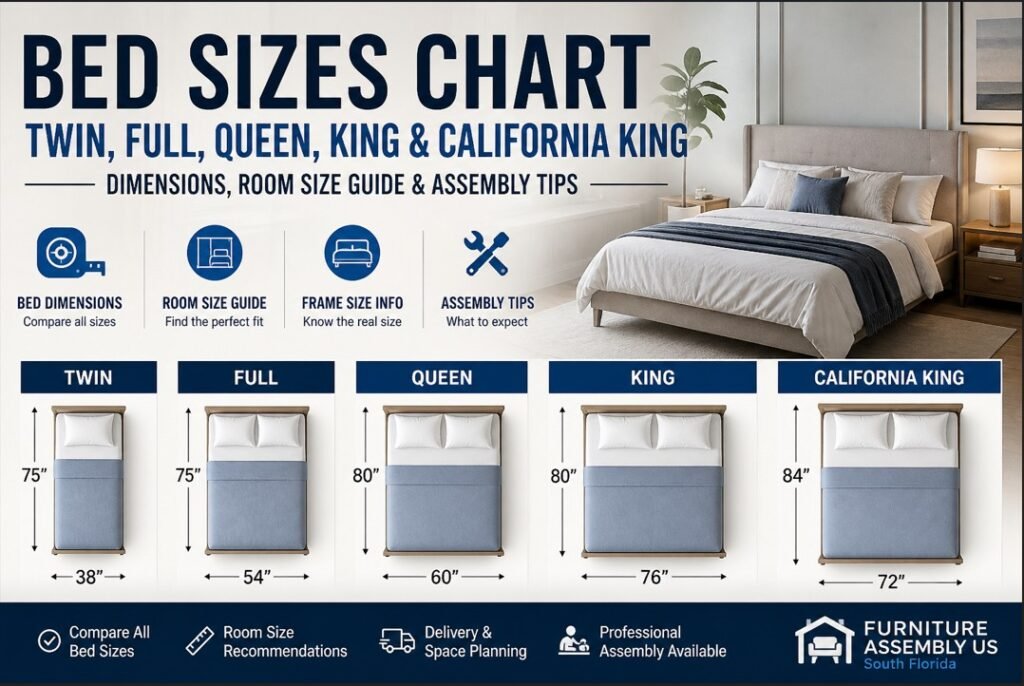
Quick Answer: Which Bed Size Should You Choose?
| Bed Size | Best Choice For | Quick Tip |
|---|---|---|
| Twin | Kids and small rooms | Saves the most floor space. |
| Full | One adult or guest room | Wider than Twin, but tight for two. |
| Queen | Most couples and apartments | Best balance of comfort and room fit. |
| King | Couples who want more width | Needs a larger bedroom. |
| California King | Tall sleepers | Longer than King, but slightly narrower. |
Quick rule: choose a Queen for most bedrooms, a King if you want extra width, and a California King if you need more legroom.
Twin
Size: 38″ × 75″
Best for: Kids, small rooms, guest spaces
Assembly: Easy
Twin XL
Size: 38″ × 80″
Best for: Tall sleepers, dorm rooms
Assembly: Easy
Full
Size: 54″ × 75″
Best for: One adult, guest rooms
Assembly: Easy–Medium
Queen
Size: 60″ × 80″
Best for: Couples, apartments
Assembly: Medium
King
Size: 76″ × 80″
Best for: Couples needing more space
Assembly: Medium–Hard
California King
Size: 72″ × 84″
Best for: Tall sleepers
Assembly: Hard
Bed Sizes Chart (U.S. Standard Dimensions)
Choosing the right bed size is not just about how much space you have to sleep. It also affects how your bedroom feels, how easily you can move around, and whether your bed frame will actually fit through doors, hallways, and elevators.
Below is a complete bed sizes chart with standard U.S. mattress dimensions, recommended room sizes, and assembly difficulty. This will help you compare options side by side and understand what works best for your space before you buy a bed frame.
Twin
Mattress: 38″ × 75″
Best for: Kids, small bedrooms, guest rooms
Min room size: 7′ × 10′
Assembly: Easy
Twin XL
Mattress: 38″ × 80″
Best for: Tall sleepers, dorms, narrow rooms
Min room size: 8′ × 10′
Assembly: Easy
Full
Mattress: 54″ × 75″
Best for: Solo adults, guest rooms
Min room size: 9′ × 10′
Assembly: Easy–Medium
Queen
Mattress: 60″ × 80″
Best for: Couples, apartments, primary bedrooms
Min room size: 10′ × 10′
Assembly: Medium
King
Mattress: 76″ × 80″
Best for: Couples wanting more space
Min room size: 12′ × 12′
Assembly: Medium–Hard
California King
Mattress: 72″ × 84″
Best for: Tall sleepers, longer rooms
Min room size: 12′ × 12’+
Assembly: Hard
Mattress Size vs Bed Frame Size: Why They Are Not the Same
Many people assume that if they buy a Queen mattress, the bed will take up exactly 60″ × 80″ of space. In reality, that is almost never the case.
A mattress has standard dimensions, but the bed frame always adds extra inches. Depending on the design, your actual bed can be wider, longer, and sometimes much bulkier than expected.
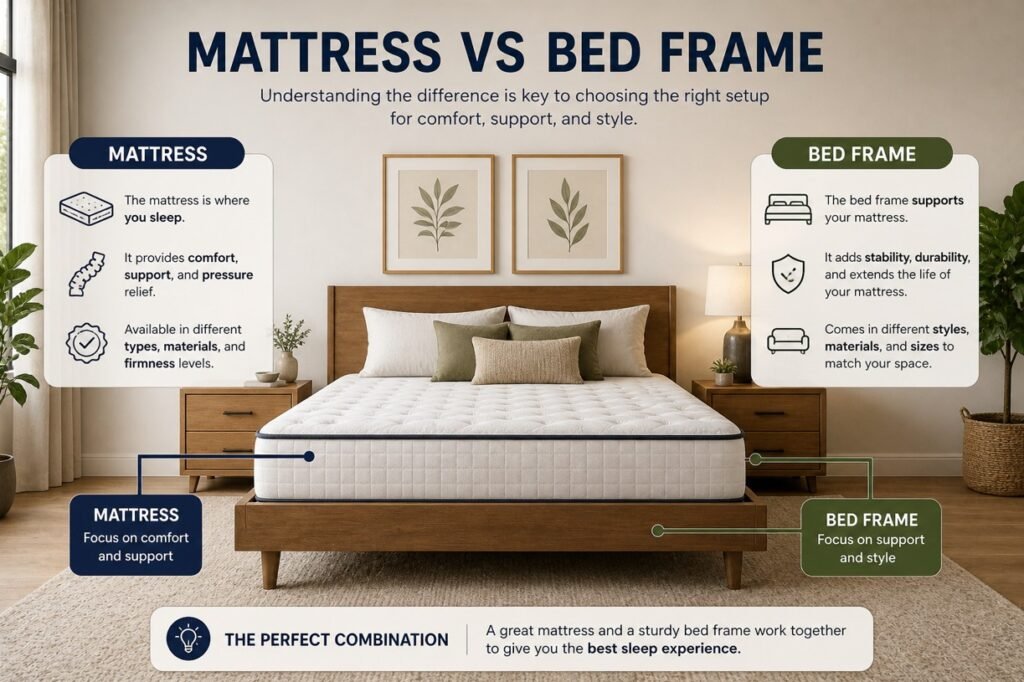
This example shows how a bed frame adds extra size beyond the mattress dimensions.
This is especially important in apartments, condos, and smaller bedrooms where every inch matters. It also affects delivery, moving, and assembly — because larger frames are harder to carry through doors, hallways, and elevators.
Different bed types affect the final footprint:
- Upholstered beds → usually wider due to padding
- Storage beds → deeper and bulkier, need space for drawers
- Platform beds → may extend beyond mattress edges
- Beds with large headboards → add extra length or height
- Canopy beds → take up significantly more visual and physical space
If you plan your room based only on mattress size, you can easily end up with a bed that feels too big for the space.
Queen Bed
Mattress size: 60″ × 80″
Typical frame footprint: 62″–68″ × 82″–88″
What adds size: Upholstery, headboard, side rails
King Bed
Mattress size: 76″ × 80″
Typical frame footprint: 78″–84″ × 82″–90″
What adds size: Wider rails, large headboards
California King
Mattress size: 72″ × 84″
Typical frame footprint: 74″–82″ × 86″–94″
What adds size: Longer rails, extended headboards
Twin Bed Dimensions: Who Should Choose a Twin Bed?
A Twin bed is the smallest standard bed size in the U.S., and it is one of the most practical options when space is limited.
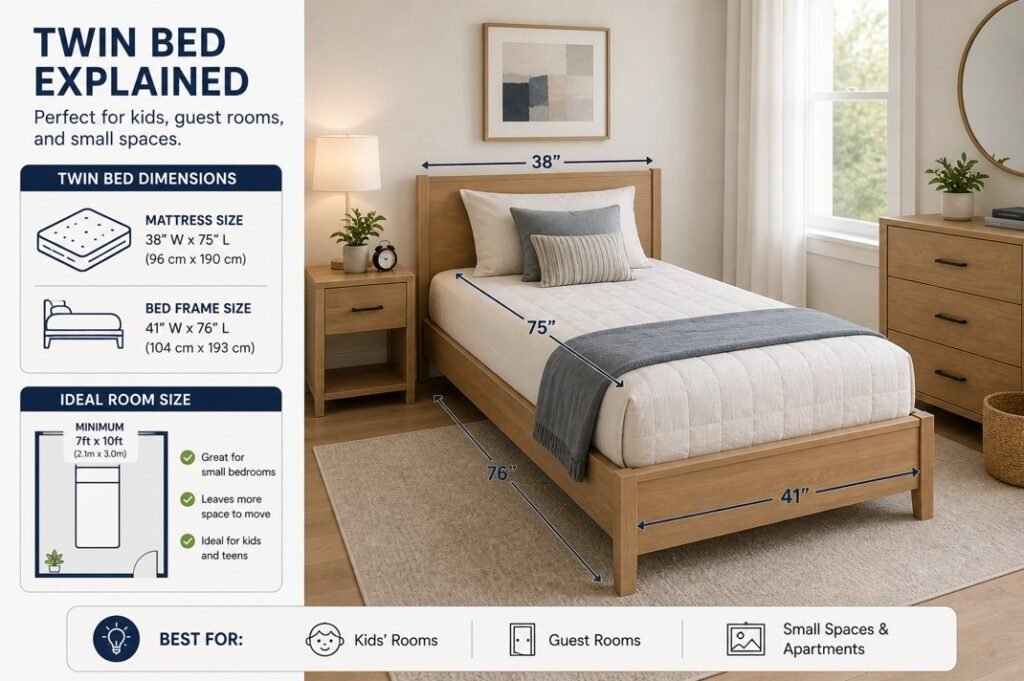
Twin bed size is 38″ × 75″, making it ideal for small rooms and guest spaces.
With dimensions of 38″ × 75″, a Twin bed is designed for one person and is most commonly used in kids’ bedrooms, small guest rooms, and compact spaces where every inch counts.
This size works especially well in apartments, rental properties, and rooms where you need to fit additional furniture like desks, dressers, or storage units.
When a Twin Bed Makes the Most Sense
A Twin bed is a smart choice if:
- You are furnishing a child’s bedroom
- You need a guest bed that doesn’t take up too much space
- You are working with a small room layout (7′ × 10′ or similar)
- You want more open floor space for movement or storage
Pros of Twin Bed
✔ Saves the most floor space
✔ Easy to move through doors and hallways
✔ Fits in small bedrooms
✔ Lower cost (mattress and frame)
✔ Quick and simple assembly
Cons of Twin Bed
✘ Too narrow for most adults
✘ Not suitable for couples
✘ Limited comfort for long-term use
✘ Less flexible if needs change later
Designer’s Note
Twin beds are ideal for small spaces because they leave room for other essential furniture. In kids’ rooms or guest rooms, this often makes the space feel more open and functional instead of crowded.
Furniture Assembler’s Note
Twin bed frames are usually the easiest to assemble because the parts are smaller and lighter. However, lower-quality metal frames can become unstable if bolts are not tightened evenly or if the frame is assembled on an uneven surface.
Twin XL Bed Dimensions: Extra Length Without Taking More Width
A Twin XL bed is very similar to a standard Twin, but with one important difference — it is 5 inches longer.
With dimensions of 38″ × 80″, a Twin XL gives you the same narrow width as a Twin bed, but extra legroom. This makes it a popular choice for taller sleepers, teenagers, and dorm-style setups.
It is also commonly used in modern adjustable beds and split setups, where flexibility matters more than width.
When a Twin XL Bed Makes the Most Sense
A Twin XL bed is a great option if:
- You are taller than average and need more legroom
- You are furnishing a teen’s bedroom
- You are setting up a guest room with limited width
- You want a modular or adjustable bed setup
Pros of Twin XL Bed
✔ Extra length for taller sleepers
✔ Fits narrow rooms like a Twin
✔ Works well for adjustable bases
✔ Can be combined into a Split King setup
Cons of Twin XL Bed
✘ Still narrow for most adults
✘ Bedding is less common than Twin
✘ Not ideal for couples
Split King Setup (Important Detail)
Two Twin XL mattresses placed side by side create a Split King configuration. This setup is popular for couples using adjustable bed bases, because each side can move independently.
Designer’s Note
Twin XL beds are a smart solution for narrow rooms where a Queen would feel too tight. They allow better layout flexibility while still accommodating taller users.
Furniture Assembler’s Note
Twin XL bed frames are still relatively easy to assemble, but adjustable bases and split setups can increase complexity. Aligning two separate frames or bases requires careful positioning to avoid gaps or uneven height.
Full Bed Dimensions: Is a Full Bed Enough for Adults?
A Full bed (also called a Double bed) is wider than a Twin but keeps the same length. Its standard size is 54″ × 75″, which gives more sleeping space for one person but can feel tight for two adults.
This size is often chosen for guest rooms, small apartments, and single sleepers who want more comfort than a Twin without moving up to a Queen.
A Full bed is also easier to move, fit into rooms, and assemble compared to larger sizes, which makes it practical for rentals and smaller homes.
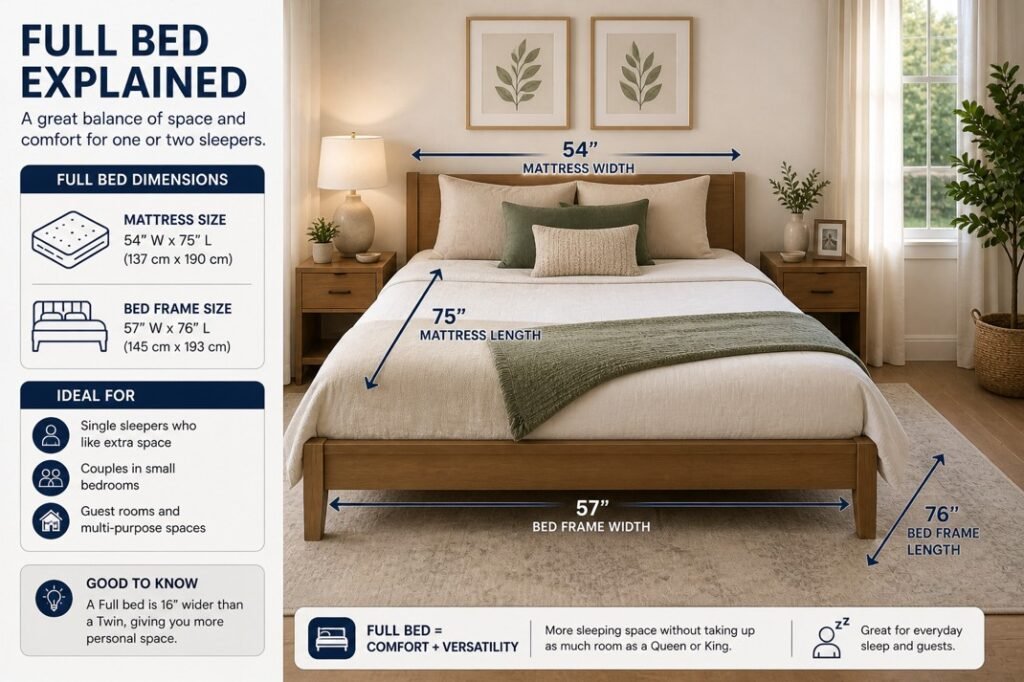
A full bed measures 54″ × 75″, offering more width than a twin while still fitting in smaller bedrooms.
When a Full Bed Makes the Most Sense
A Full bed is a good choice if:
- You are a single adult who wants more width than a Twin
- You are furnishing a guest room
- Your bedroom is too small for a Queen
- You want something more affordable and easier to move
Pros of Full Bed
✔ More width than Twin
✔ Good for one adult
✔ Fits smaller bedrooms
✔ Easier to move than Queen or King
✔ Usually more affordable
Cons of Full Bed
✘ Tight for two adults
✘ Same length as Twin (not ideal for tall people)
✘ Less resale appeal than Queen
✘ Limited long-term flexibility
Full vs Queen: Key Differences
One of the most common questions is whether to choose a Full or upgrade to a Queen. The difference in width may not sound huge on paper, but in real life it makes a big impact.
| Feature | Full | Queen |
|---|---|---|
| Width | 54″ | 60″ |
| Length | 75″ | 80″ |
| Best for | One adult | Couples |
| Room fit | Smaller rooms | More space needed |
| Assembly | Easy–Medium | Medium |
Designer’s Note
A Full bed is often a smart compromise in smaller bedrooms where a Queen would feel too tight. It leaves more walking space and allows room for nightstands or dressers.
Furniture Assembler’s Note
Full bed frames are still relatively easy to assemble, but larger headboards, slats, and support beams can add time. Compared to a Queen, the process is usually faster and easier, especially in tight rooms.
Queen Bed Dimensions: Why Queen Is the Most Popular Bed Size
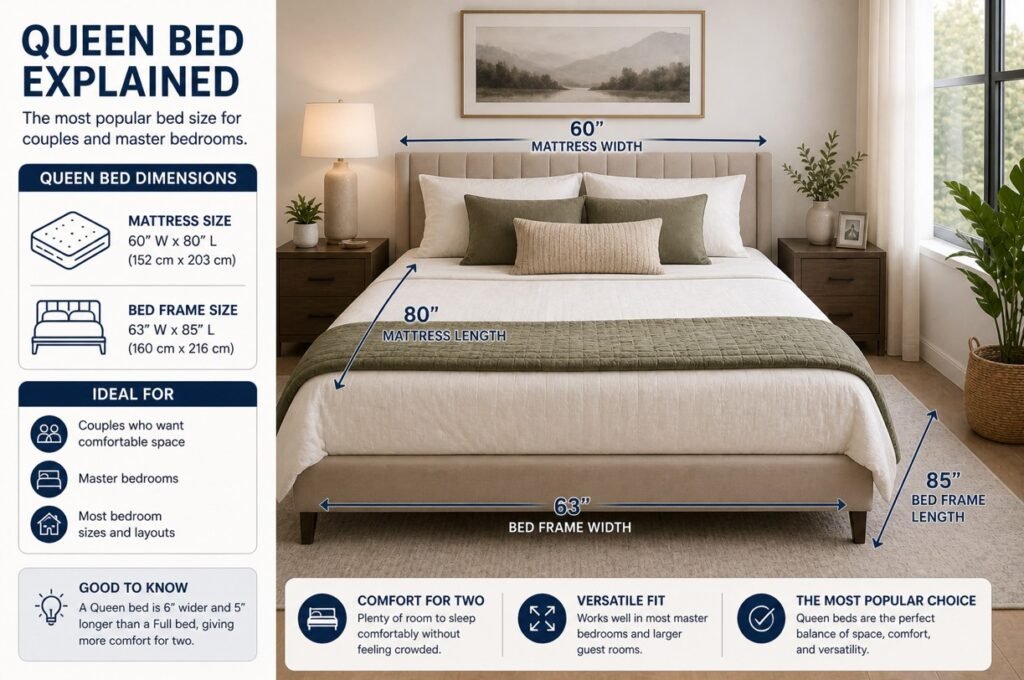
A Queen bed is the most popular bed size in the U.S. because it offers the best balance between comfort, space, and practicality.
With standard dimensions of 60″ × 80″, a Queen bed provides enough room for two adults while still fitting comfortably in most bedrooms, apartments, and condos.
This is why it is often considered the “safe choice” — it works well in most situations without overwhelming the room.
When a Queen Bed Makes the Most Sense
A Queen bed is the right choice if:
- You are a couple looking for a comfortable everyday bed
- You are furnishing a primary bedroom
- You live in an apartment or condo
- You want a bed that is easy to resell or reuse later
Pros of Queen Bed
✔ Comfortable for most couples
✔ Fits most bedrooms
✔ Widely available (mattresses, frames, bedding)
✔ Best balance of size and usability
✔ Strong resale value
Cons of Queen Bed
✘ May feel tight for couples who want more space
✘ Larger than Full (less floor space)
✘ Can be harder to move in tight hallways
Room Fit: How Much Space Do You Need for a Queen Bed?
A Queen bed typically requires at least a 10′ × 10′ room to fit comfortably.
However, that is just the minimum. To make the room feel functional and not cramped, you should also consider:
- Space for nightstands
- Clearance for walking around the bed
- Space for closets and doors to open
Small-space tip: Try to leave at least 24 inches of walking space on each accessible side of the bed.
Designer’s Note
A Queen bed is often the best balance between comfort and room flow. It provides enough sleeping space without dominating the entire bedroom, which is especially important in apartments and condos.
Furniture Assembler’s Note
Queen bed frames are usually manageable for two people, but complexity depends on the design.
- Simple platform beds → relatively easy
- Storage beds with drawers → more time-consuming
- Hydraulic lift beds → significantly harder
- Large upholstered headboards → heavier and harder to position
In many cases, assembly is still realistic as a DIY project — but it can quickly become time-consuming without the right tools or experience.
Understanding the exact queen bed size helps you plan your bedroom layout correctly from the start.
King Bed Dimensions: Maximum Space and Comfort for Couples
A King bed offers the most sleeping space in standard bed sizes, making it ideal for couples who want extra room to stretch out.
With dimensions of 76″ × 80″, a King bed is significantly wider than a Queen, giving each person more personal space. This makes it a great option for couples, families with kids, or anyone who shares the bed with pets.
However, that extra space comes with trade-offs — a King bed requires a larger room, is harder to move, and more complex to assemble.
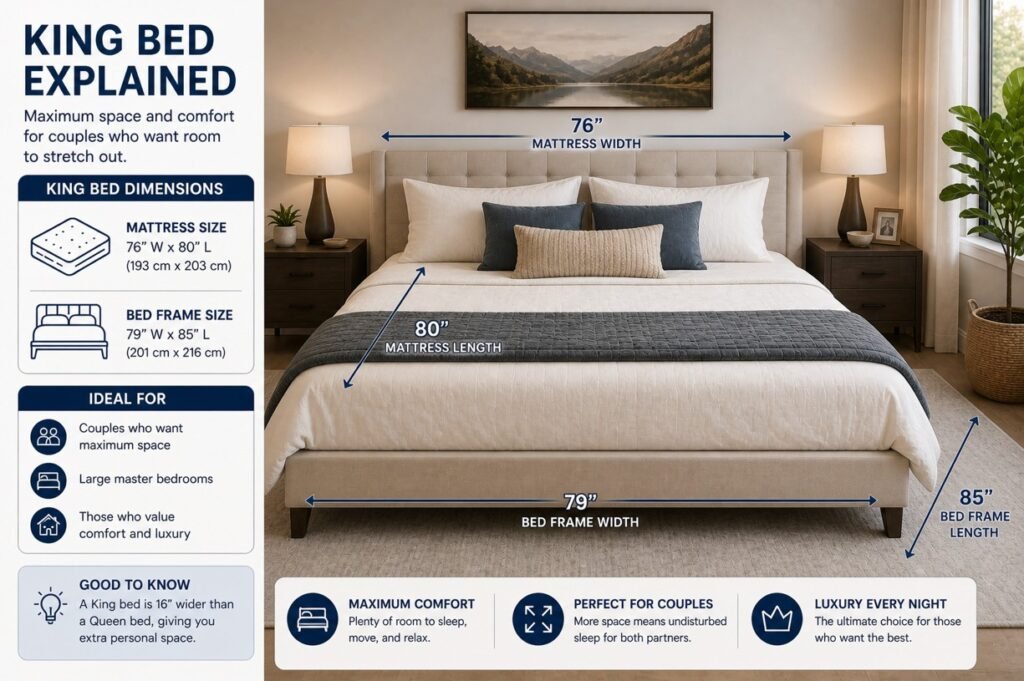
King bed size is 76″ × 80″, offering maximum width and comfort for couples.
When a King Bed Makes the Most Sense
A King bed is a strong choice if:
- You are a couple who wants more personal space
- You sleep with kids or pets
- You have a larger primary bedroom (12′ × 12′ or more)
- You want a more luxurious sleeping setup
Pros of King Bed
✔ Maximum width and personal space
✔ Ideal for couples, families, and pets
✔ Comfortable for long-term use
✔ Premium, luxury feel
Cons of King Bed
✘ Requires a large bedroom
✘ Harder to move through doors and hallways
✘ Heavier bed frame components
✘ More complex assembly
Queen vs King: Key Differences
The jump from Queen to King may not seem huge on paper, but it makes a noticeable difference in real life — especially for couples.
| Feature | Queen | King |
|---|---|---|
| Width | 60″ | 76″ |
| Length | 80″ | 80″ |
| Best for | Most couples | Couples wanting more space |
| Room fit | Easier | Needs more space |
| Assembly | Medium | Medium–Hard |
Designer’s Note
A King bed works best in larger rooms where there is enough space around the bed. In smaller bedrooms, it can make the room feel cramped and limit movement.
Furniture Assembler’s Note
King bed frames are more difficult to assemble due to their size and weight.
- Longer side rails
- Heavier headboards
- More support beams and slats
In apartments or condos, maneuvering parts through elevators, staircases, and tight hallways can be one of the biggest challenges.
California King Bed Dimensions: More Length for Taller Sleepers
A California King bed is designed for people who need extra legroom. It is longer but slightly narrower than a standard King.
With dimensions of 72″ × 84″, it is the longest standard bed size in the U.S., making it ideal for taller individuals or anyone who feels cramped in a regular King bed.
However, many people assume it is simply a “bigger King,” which is not entirely true. The difference in shape can affect comfort, room layout, and furniture placement.
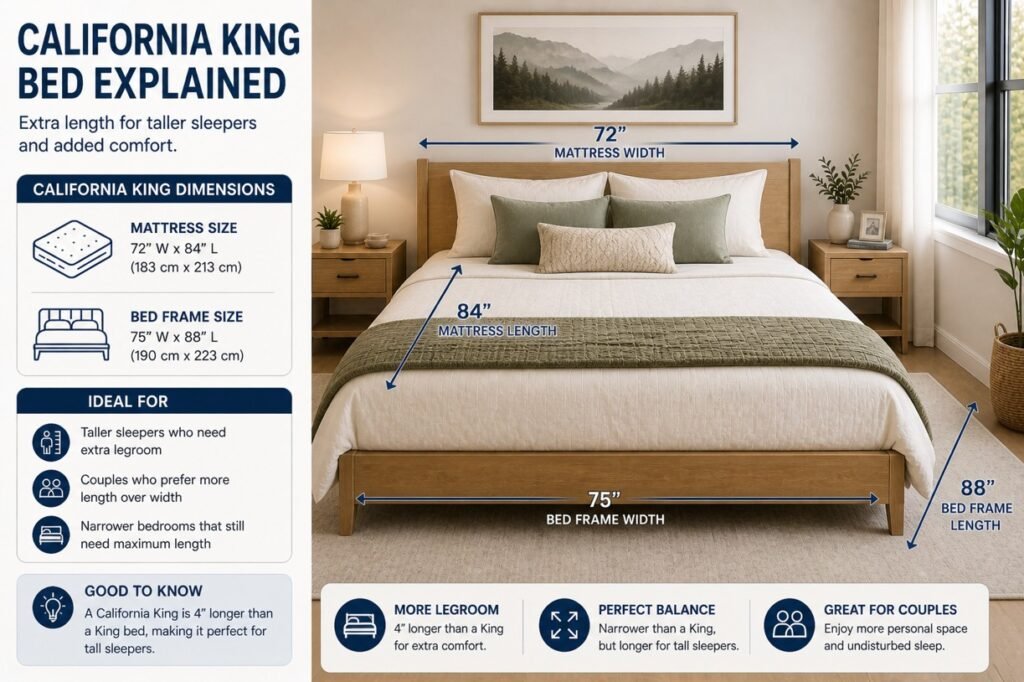
California king bed size is 72″ × 84″, offering extra length for taller sleepers and narrow rooms.
When a California King Makes the Most Sense
A California King bed is a good choice if:
- You are taller than average and need more legroom
- Your bedroom is longer rather than wider
- You want a more specialized or premium setup
Pros of California King
✔ Extra length for tall sleepers
✔ Better fit for long, narrow rooms
✔ Premium feel and unique size
Cons of California King
✘ Narrower than a standard King
✘ Bedding is less common
✘ Requires large room
✘ Harder to move and assemble
King vs California King: Key Differences
Even though both are large beds, they are designed for different needs.
| Feature | King | California King |
|---|---|---|
| Width | 76″ | 72″ |
| Length | 80″ | 84″ |
| Best for | More side-to-side space | Taller sleepers |
| Room shape | Wider rooms | Longer/narrow rooms |
| Assembly | Medium–Hard | Hard |
Designer’s Note
California King beds work best in longer bedrooms where the extra length improves comfort without making the room feel too tight on the sides.
Furniture Assembler’s Note
California King bed frames are often the most difficult to assemble due to their length. Longer rails, larger headboards, and heavier components make positioning and alignment more challenging — especially in tight spaces like condos or apartments.
How to Choose the Right Bed Size for Your Room
Choosing the right bed size is not only about comfort — it is about how the bed fits into your space in real life.
A bed that looks perfect in a store or online can feel too large once it is inside your bedroom. This usually happens because people measure only the mattress size and forget about walking space, furniture placement, and how the bed frame actually fits into the room.
Before buying a bed, you should always plan the full layout of the room, not just the sleeping area.
What You Should Measure Before Buying a Bed
To avoid common mistakes, measure:
- Room width and length
- Space for nightstands
- Clearance for walking around the bed
- Space for closet doors and drawers
- Entry points like doors, hallways, stairs, and elevators
A good rule is to leave at least 24 inches of walking space around the bed where possible. If space allows, 30–36 inches feels much more comfortable, especially near the foot of the bed.
Small Room
Room size: ~7′ × 10′
Best bed: Twin
Tip: Focus on saving floor space
Compact Room
Room size: ~8′ × 10′
Best bed: Twin XL
Tip: Good for taller sleepers in small spaces
Small Bedroom
Room size: ~9′ × 10′
Best bed: Full
Tip: Better comfort for one person
Standard Bedroom
Room size: ~10′ × 10′
Best bed: Queen
Tip: Best balance of space and comfort
Large Bedroom
Room size: ~12′ × 12′
Best bed: King
Tip: Works if you have extra space
Spacious Room
Room size: 12′ × 12’+
Best bed: King / California King
Tip: Choose based on room shape
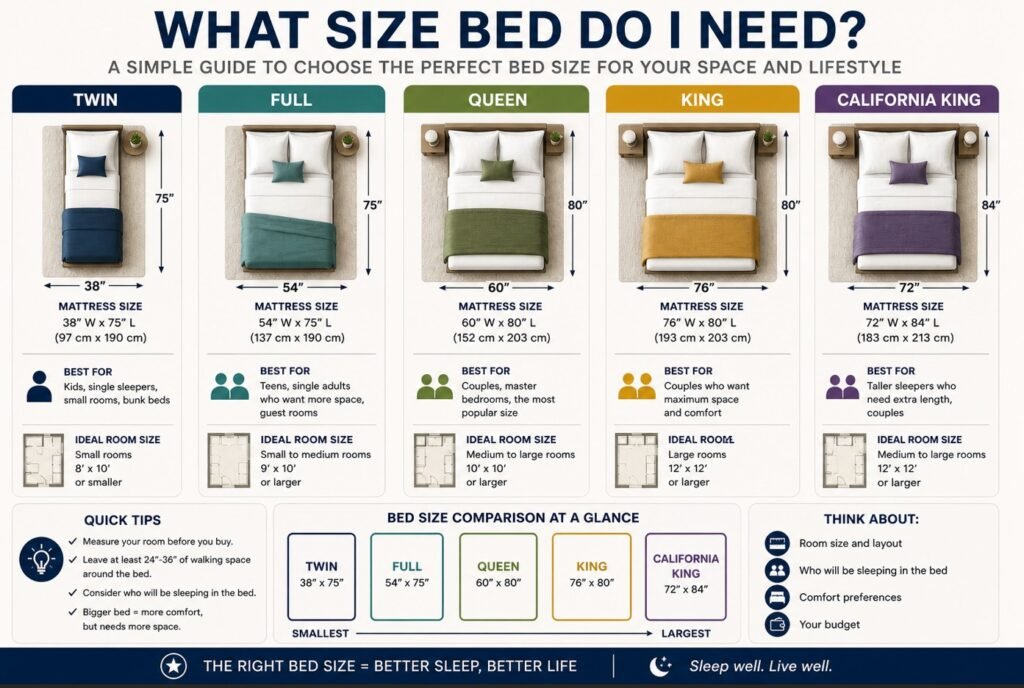
Not sure what size bed you need? Use this guide to compare dimensions and choose the best fit for your room.
Small-Space Planning Tip
If you live in an apartment or condo, especially in cities like Boca Raton, Fort Lauderdale, or West Palm Beach, space is often limited. In these cases, choosing a slightly smaller bed (like a Full instead of a Queen) can make the room feel significantly more open and functional.
Mover’s Note
Many bed frames — especially King and California King — are difficult to move through tight hallways, staircases, and elevators. Always check access points before buying, not just the room size.
Furniture Assembler’s Note
Larger beds not only take more space — they also require more effort to assemble. Longer rails, heavier headboards, and additional support systems increase both assembly time and complexity.
Best Bed Size by Lifestyle: What Works for Real Life Situations
Choosing a bed size is not just about measurements — it is about how you actually live.
Your lifestyle, habits, and daily routine matter just as much as room size. A bed that works perfectly for one person may feel completely wrong for another, even in the same space.
Below is a practical guide to help you choose the right bed size based on real-life situations.
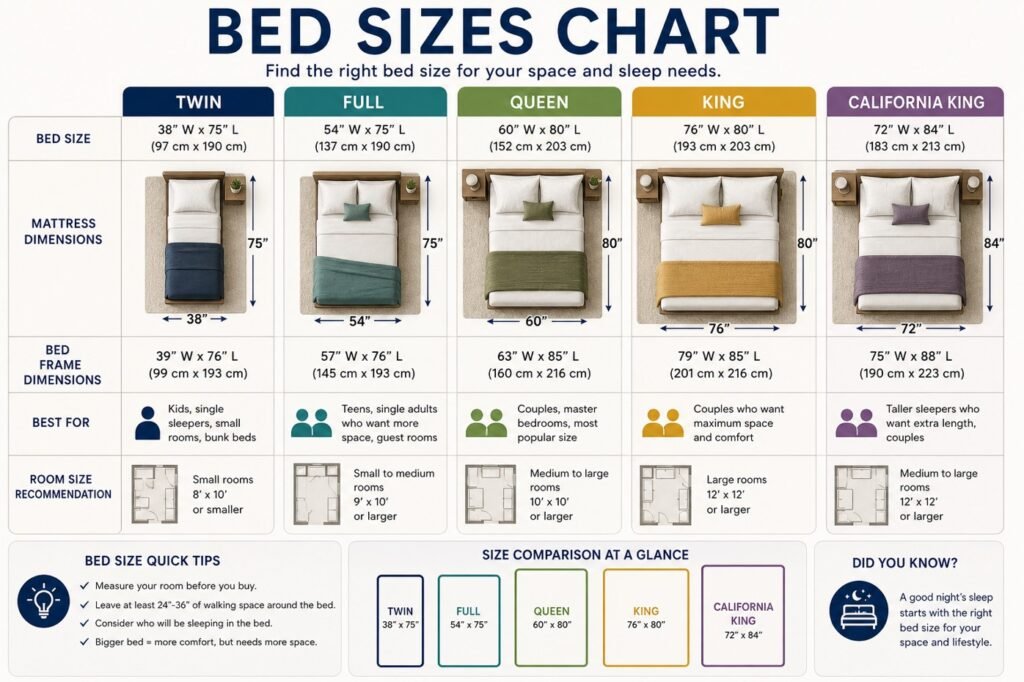
Save this bed sizes chart to compare mattress dimensions and choose the right bed for your space.
Child’s Bedroom
Best bed: Twin
Why: Saves space and leaves room for play, desks, and storage
Tall Teenager
Best bed: Twin XL
Why: Extra legroom without taking more width
Studio Apartment
Best bed: Full or Queen
Why: Balance between comfort and limited space
Couple (Apartment)
Best bed: Queen
Why: Comfortable without overwhelming the room
Couple with Pets
Best bed: King
Why: Extra space for movement and comfort
Tall Sleeper
Best bed: California King
Why: Maximum length for better sleep comfort
Guest Room
Best bed: Full or Queen
Why: Flexible for different types of guests
Luxury Primary Bedroom
Best bed: King
Why: Premium comfort and spacious feel
Real-Life Tip
Many people choose a bed based only on room size, but lifestyle often matters more. For example, a couple with pets may quickly outgrow a Queen bed, while a single person in a small apartment may prefer a Full to keep the space open.
Furniture Assembler’s Note
The larger and more complex the bed, the more time assembly takes. Lifestyle choices like storage beds, adjustable bases, or luxury frames often increase assembly difficulty — even if the bed size stays the same.
Assembly Difficulty by Bed Size: What to Expect Before You Start
Not all bed frames are equally easy to assemble. Even if two beds look similar, their size, weight, and design can make a big difference in how long assembly takes and how difficult the process will be.
Smaller beds are usually faster and easier to assemble, while larger beds require more time, more space, and often a second person.
The type of bed frame also matters:
- Basic metal frame → easiest
- Platform bed → moderate
- Storage bed with drawers → harder
- Hydraulic lift bed → most complex
Twin
Difficulty: Easy
Why: Lightweight parts, shorter rails, fewer components
Full
Difficulty: Easy–Medium
Why: Slightly larger frame but still manageable solo
Queen
Difficulty: Medium
Why: Larger parts, usually requires two people
King
Difficulty: Medium–Hard
Why: Wide rails, heavy headboards, more support pieces
California King
Difficulty: Hard
Why: Long rails, large footprint, harder positioning
What Makes Bed Assembly More Difficult
Even within the same size, some beds are much harder to assemble than others.
Common factors that increase difficulty:
- Storage drawers → require alignment and extra hardware
- Hydraulic lift systems → heavy and complex mechanisms
- Large upholstered headboards → bulky and hard to position
- Low-quality instructions (common with some brands)
- Tight spaces (apartments, condos, narrow rooms)
Can You Assemble a Bed Frame Yourself?
- Twin / Full → usually easy for one person
- Queen → possible DIY, but easier with two people
- King / California King → often requires two people and more time
If you don’t have the right tools, enough space, or experience, assembly can quickly become frustrating and time-consuming.
Professional Assembly Tip
Incorrect assembly can lead to:
- Wobbly frames
- Noise and instability
- Misaligned parts
- Faster wear and damage
A properly assembled bed frame not only looks better but also lasts longer and feels more stable.
Common Mistakes When Choosing a Bed Size
Choosing a bed size may seem simple, but in reality, many people make the same mistakes — and only realize it after the bed is delivered and assembled.
These mistakes can lead to poor room layout, limited movement, or even the need to replace the bed entirely.
Here are the most common issues to avoid.
Measuring Only the Mattress
Many people forget that the bed frame adds extra width and length. This can make the bed too large for the room.
Ignoring the Headboard Size
Large headboards can add several inches to the total footprint and affect wall placement.
Choosing a King for a Small Room
A King bed may fit on paper, but it can leave no space for walking, nightstands, or drawers.
Forgetting About Doors and Hallways
Bed frame parts must fit through doors, stairs, and elevators — not just inside the room.
Not Planning for Nightstands
Without space for nightstands, the bedroom becomes less functional and less comfortable.
Ignoring Drawer Clearance
Storage beds need extra space for drawers to open fully, which many people forget to measure.
Assuming All Frames Fit Perfectly
Not all bed frames match mattress sizes exactly. Some are wider or longer depending on design.
Underestimating Assembly Complexity
Larger beds and storage frames often take longer and require more effort than expected.
Real-Life Tip
Most problems happen not because the bed is “wrong,” but because it was chosen without considering the full setup — room layout, furniture placement, and assembly.
Planning just a little ahead can save time, money, and frustration.
Furniture Assembler’s Note
One of the most common service calls happens after a customer buys a bed that technically fits the room — but is extremely difficult to assemble in the available space. Tight corners, limited clearance, and heavy parts can turn a simple setup into a complicated job.
Bed Size Planning in South Florida Apartments and Condos
Choosing the right bed size in South Florida is often more complicated than it seems — especially in apartments, condos, and high-rise buildings.
Even if the bed fits your room perfectly on paper, real-life factors like elevators, parking, hallways, and building layouts can make a big difference.
In cities like Boca Raton, Fort Lauderdale, West Palm Beach, Delray Beach, and surrounding areas, many homes have:
- Narrow hallways and tight corners
- Elevator size limitations
- Limited parking or loading zones
- Strict building rules for moving and deliveries
This means that larger beds — especially King and California King — can be difficult not only to assemble, but even to bring inside the unit.
Why Bed Size Matters More in Condos
In houses, you usually have more flexibility. But in condos and apartments:
- You may not have enough space to rotate large bed parts
- Long rails (King / Cali King) can be difficult to fit into elevators
- Heavy headboards are harder to carry upstairs or through tight entries
- Storage beds may not open properly due to limited clearance
Even a Queen bed can feel large if the room layout is tight.
Moving into a Condo
Large bed frames may not fit easily in elevators or tight hallways.
Small Apartment Bedroom
A Queen may fit better than a King for comfort and movement.
Luxury High-Rise
King beds are common, but delivery and assembly can be more complex.
Same-Day Move-In
Quick assembly becomes important when time is limited.
Furniture Assembler’s Note
In South Florida, one of the biggest challenges is not the assembly itself — it is working within the space available.
Tight rooms, limited clearance, and building restrictions can make even a standard bed setup more difficult than expected.
When Professional Assembly Makes Sense
If you already chose your bed size but want to avoid:
- Damaging walls or floors
- Struggling with heavy parts
- Spending hours on confusing instructions
- Dealing with tight spaces
…it often makes sense to use a professional service.
If you are located in Broward County or Palm Beach County, our team at Furniture Assembly US can help assemble your bed frame safely and efficiently — including IKEA, Wayfair, Amazon, and Ashley Furniture beds.
Related Guides and Helpful Resources
If you are planning to buy or assemble a bed, it helps to understand the full process — from choosing the right size to moving and assembling the frame safely.
Below are useful guides that can help you go further.
Professional help for assembling bed frames quickly and correctly.
Step-by-step guide for one of the most popular IKEA bed frames.
What to expect when assembling Ashley bed frames.
Tips to avoid injuries and damage when moving large furniture.
Smart solutions for apartments and compact rooms.
Overview of professional assembly services in your area.
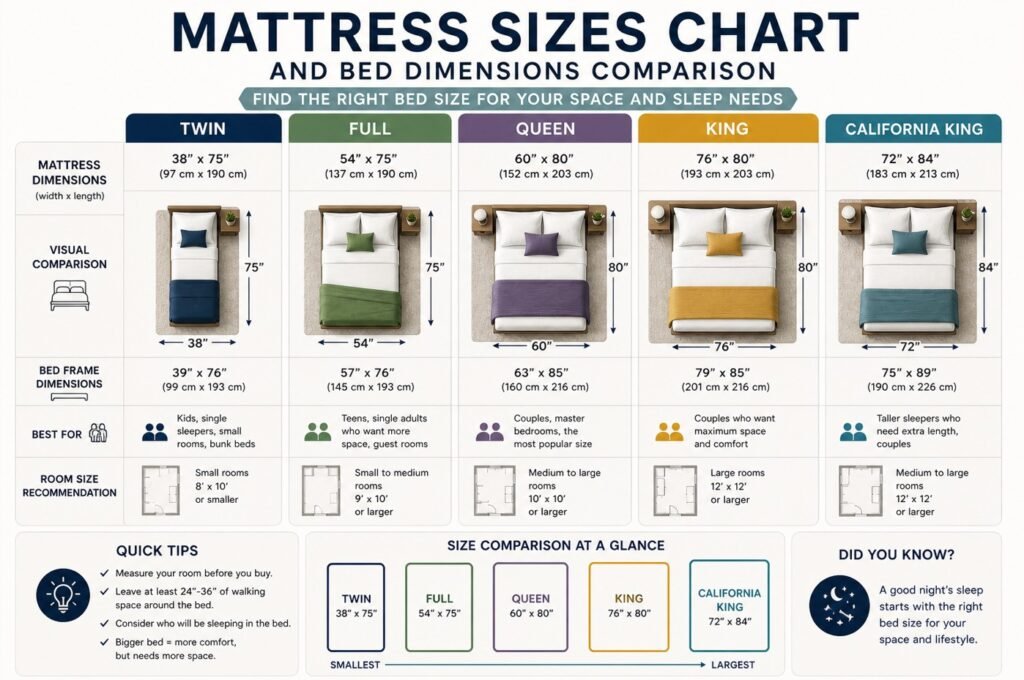
Compare mattress sizes and bed dimensions to choose the right fit for your room.
FAQ: Bed Sizes, Room Fit, and Assembly
Choosing a bed size often raises practical questions — not just about dimensions, but about comfort, room layout, and assembly.
Here are the most common questions people ask before buying a bed.
What are the standard bed sizes in the U.S.?
Standard bed sizes in the U.S. are: Twin (38″ × 75″), Twin XL (38″ × 80″), Full (54″ × 75″), Queen (60″ × 80″), King (76″ × 80″), and California King (72″ × 84″).
What is the most popular bed size?
Queen is the most popular bed size because it offers a good balance between comfort, room fit, and affordability.
Is a Queen bed big enough for two adults?
Yes, a Queen bed is comfortable for most couples. However, if you prefer more personal space or sleep with pets, a King bed may be a better option.
What is the difference between King and California King?
A King bed is wider (76″), while a California King is longer (84″). King is better for couples who want more width, while California King is better for taller sleepers.
What size room do I need for a Queen bed?
A Queen bed typically requires at least a 10′ × 10′ room. For better comfort, it is recommended to have extra space for walking and furniture.
What size room do I need for a King bed?
A King bed usually needs a room of at least 12′ × 12′ to allow enough space for movement and additional furniture.
Does bed frame size match mattress size exactly?
No, bed frames are usually slightly larger than the mattress due to structural elements, headboards, and design features.
Is a King bed frame hard to assemble?
Yes, King bed frames are more difficult to assemble because they have larger and heavier components and often require more time and effort.
Can one person assemble a Queen bed frame?
It is possible, but usually easier and faster with two people, especially when dealing with larger parts or heavy headboards.
Should I hire a professional to assemble a bed frame?
If the bed is large, complex, or you have limited time or tools, hiring a professional can save time and help avoid assembly mistakes.
Choosing the Right Bed Size Matters More Than You Think
Choosing the right bed size is not just about comfort — it affects your entire bedroom setup.
The size you pick will impact:
- How your room feels and functions
- How much space you have to move around
- Whether your furniture layout works
- How easy it is to deliver, move, and assemble the bed
A Queen bed is the best all-around choice for most people, while a King or California King works better in larger bedrooms with more space. Smaller options like Twin and Full are ideal for compact rooms, guest spaces, and practical setups.
The key is to think beyond the mattress and plan for the full bed frame footprint, room layout, and real-life conditions.
Final Tip Before You Buy
Before ordering a bed frame, make sure to:
- Measure your room carefully
- Check walking clearance and furniture placement
- Consider doors, hallways, and elevators
- Think about assembly complexity
A few extra minutes of planning can save hours of frustration later.
Need Help with Bed Frame Assembly in South Florida?
If you already chose the right bed size but don’t want to spend hours dealing with instructions, tools, and heavy parts, professional help can make the process much easier.
Furniture Assembly US provides reliable bed frame assembly services in:
- Boca Raton
- Fort Lauderdale
- West Palm Beach
- Delray Beach
- Boynton Beach
- Pompano Beach
- Deerfield Beach
- Hollywood
- All Broward County and Palm Beach County
We assemble:
- IKEA beds (including MALM and other models)
- Wayfair and Amazon bed frames
- Ashley Furniture beds
- Storage beds, platform beds, and more
Whether you are moving into a new apartment or upgrading your bedroom, our team can help you set up your bed quickly, safely, and correctly.